Supply Chains Don't Lie
The Canton Fair, Shenzhen, and the real direction of global trade

“Supply chains don’t lie.”
A friend of mine who specializes in China-focused global supply chains said that to me over coffee this week in Shenzhen. His point was simple: ignore what companies and governments say, and watch what they do. Actions reveal strategy far more than newswire announcements.
For the past three years, a steady stream of commentary has pushed variations of a similar narrative: companies are fleeing China, supply chains are rerouting, and a kind of slow-motion global divorce is underway. De-Chinafy to avoid risk!
I’ve never fully bought it. From my own experience in China - meeting people, helping Chinese companies go abroad, and supporting foreign companies doing business here - the story looks very different on the ground.
I’ll tell you what I’ve noticed this year in Shenzhen: way more foreigners. More Laowai walking the streets, sitting in the coffee shops, taking meetings, visiting factories. Way more Laowai speaking Chinese, too. The vibe has shifted. There is genuine energy here that doesn’t make it into the international press, because “foreigner visits Shenzhen factory and finds great partner” doesn’t generate clicks the way “China risk” does.
The thing about the more alarming headlines in the West is that they’re not exactly wrong. Tariffs are real. Geopolitical friction is real. Some supply chains have genuinely shifted. But these headlines flatten a much more complex picture into a single narrative, one that leans heavily toward risk and tends to overlook opportunity.
The Canton Fair is a great example of this. It’s something I rarely see mentioned in international news, and yet this week in Guangzhou, somewhere around 300,000 foreign buyers are descending on the city. That’s more than three times the total attendance at CES 2026 in Las Vegas. Many of the buyers are coming from Latin America, Africa, and Belt and Road countries.
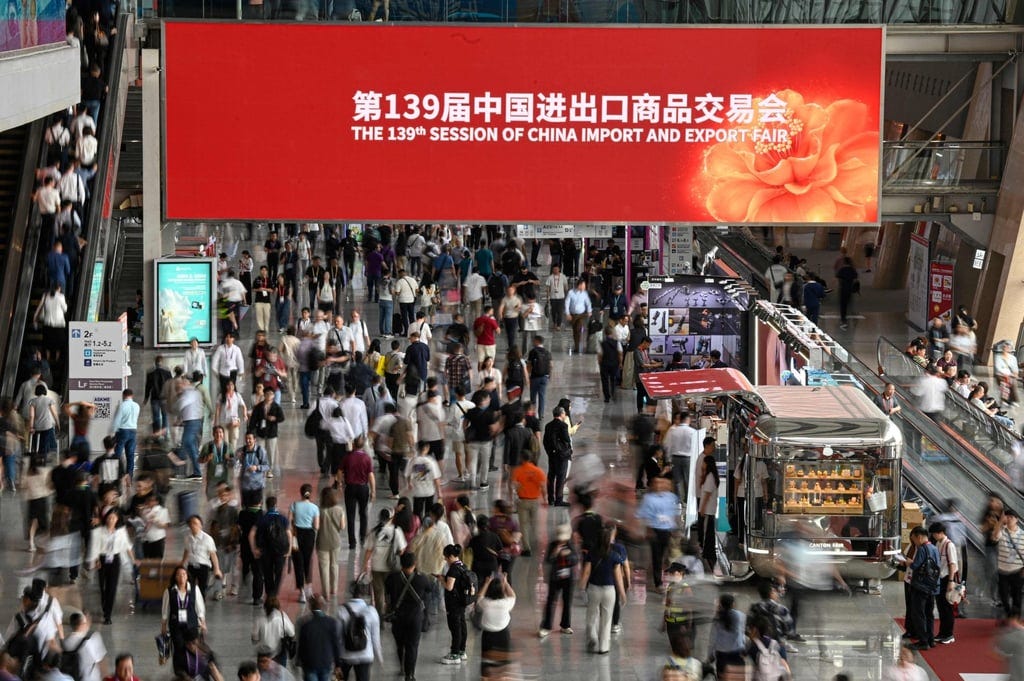
The executives flying into Guangzhou this week are weighing risk against opportunity and deciding that the trip is worth it. Many of them are veterans who have been coming to the Canton Fair for decades. These are the kinds of decisions my supply chain friend was talking about. When hundreds of thousands of people choose to attend, that’s a real business signal, stronger than any headline. People vote with their time and their money. Actions don’t lie.
Yes, manufacturing is moving, especially to Vietnam, Mexico, Indonesia, and India. But that movement is being driven by Chinese companies themselves. Chinese manufacturers are establishing production bases overseas to get closer to end markets, navigate tariff structures, and expand their global footprint.
In other words, Chinese supply chain infrastructure is not shrinking away from the world, but rather is embedding itself deeper into it. The “Made in Vietnam” label on your electronics may increasingly mean: designed in Shenzhen, financed in Shanghai, and assembled in Hanoi. And in many cases, the government relationships and local networks are now in Chinese hands too, not just the manufacturing processes.
What I See on the Ground
The most interesting thing about all of this is the perspective between East and West. When North Americans say “the world is decoupling from China”, they aren’t technically incorrect, but what they mean is that “their world” is decoupling from China. The rest of the world is deepening strategic partnerships and increasing trade while North America is being left in the rearview mirror.
Life is improving across much of Asia, Southeast Asia, and parts of the Middle East and North Africa, helped in part by more open economic policies. Western countries, on the other hand, are moving in the exact opposite direction: by becoming increasingly inward-looking, they are facing slower growth. As I noted recently in an interview with Xinhua News, success tends to favour those who stay open to the world.
This is the gap that keeps costing Western and international businesses money. The news cycle and what is actually happening on the ground in China are often two different things. If you are making business decisions based on headlines alone, you are essentially navigating with a map drawn by someone who has never been here.
The Only “China Strategy” That Works
There is no algorithm for finding the right partner in China. There is no due diligence report that can substitute a handshake. The companies and laowai I know in China who have built durable, profitable relationships with Chinese enterprises share a common denominator: they spend time here.
They visit factories. They go to trade fairs. They order a latte at Luckin Coffee using Alipay or WeChat. They sit through banquets, listen to the boring speeches, and add everyone they meet on WeChat. They build relationships before they need them. In short, they treat China as a real place with real people, and create real connections. It sounds simple, but after more than 20 years here, I can say that very few people actually do it. The ones who do are the ones who succeed.

That’s why I think the Canton Fair is, in many ways, one of the most honest barometers of where global trade with China actually stands. It shows who is still coming, and who is not. In that sense, it is as useful a metric as any for future market direction.
If you are thinking about how to do business in or with China, here is my sincere advice: book a flight to Shenzhen, stay in Nanshan District and look around. Try ordering lunch with Meituan Delivery. Walk around and be open, say hello, and add people on WeChat when you meet them. And of course, come visit my office at China Resource Tower for a coffee.
The real China, the one that 300,000 buyers are experiencing in Guangzhou right now, is only really accessible in person.